
UNIQUE MECHANISM
OF ACTION
NEMLUVIO is the first and only neuroimmune-targeted treatment to directly block IL‑31RA1,2
NEMLUVIO® disrupts PN and AD from the inside and outside by blocking IL-31 signaling

Mechanism of disease
Unlike other cytokines, overexpression of IL-31 and IL-31RA has been shown to be a direct driver of itch and more. IL‑31 binds to receptors across multiple cell types to drive PN and AD1,2
Mechanism of action
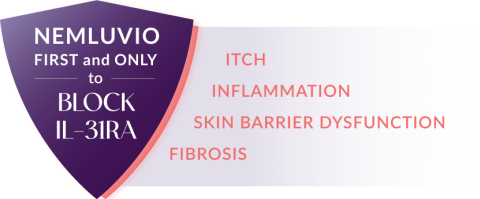
NEMLUVIO targets an IL-31 receptor, blocking signaling that drives itch, inflammation, skin barrier dysfunction, and fibrosis1,2
NEMLUVIO is the first-of-its-kind, neuroimmune-targeted treatment to block IL‑31 signaling in four ways1,2
NEMLUVIO blocks the urge to scratch and helps heal the skin from the inside out1,2
Hover over or click each card to reveal NEMLUVIO's action in each pathway
Blocks the urge
to scratch
Helps block the urge to scratch in the sensory nerves in the skin and on the dorsal root ganglion1,2
PROMOTES SKIN
HEALING THROUGH
DOWNREGULATION
Promotes skin healing by downregulating multiple inflammatory pathways including type 2 inflammation (such as IL‑13)1‑4
HELPS RESTORE THE SKIN
BARRIER FROM WITHIN
Helps restore the skin barrier from within by blocking IL-31RA on keratinocytes1‑5
BLOCKS DRIVERS OF
SKIN THICKENING
Blocks IL-31RA on fibroblasts, which are drivers of skin thickening and lichenification1‑5
WATCH THE VIDEO BELOW TO LEARN MORE ABOUT HOW NEMLUVIO WORKS

NEMLUVIO is a humanized IgG2 monoclonal antibody.1
IL-31, the neuroimmune cytokine, directly drives disease processes by binding to IL-31 receptor alpha to: activate sensory nerves in the skin and on the dorsal root ganglion to amplify the itch signal to the brain, which compels the patient to scratch, interact with multiple cell types to drive TH2 and non-TH2 inflammation, interfere with keratinocyte differentiation that leads to skin barrier dysfunction, stimulate fibroblasts to induce collagen deposition and tissue remodeling that result in fibrosis.
NEMLUVIO is the first and only neuroimmune treatment that targets IL-31 signaling to work across four disease processes: blocking signals in the sensory nerves and uniquely on the dorsal root ganglion to directly suppress itch, blocking IL-31 receptor alpha to disrupt a key cause of harmful inflammation in the immune system, blocking the IL-31RA on keratinocytes to normalize the skin barrier, and finally, NEMLUVIO blocks the IL-31RA on fibroblasts to inhibit pro-fibrotic and inflammatory responses to heal nodules.
Fast Itch Relief12
See how NEMLUVIO significantly improved itch in both pivotal and long-term studies12,13

Patient Profiles
Take a closer look at the types of patients who may benefit from NEMLUVIO
Sign up now for more information about NEMLUVIO for PN
AD=atopic dermatitis; IL-31=interleukin‑31; IL‑31RA=interleukin‑31 receptor alpha; PN=prurigo nodularis.
References: 1. NEMLUVIO (nemolizumab-ilto) injection 30 mg Prescribing Information. Dallas, TX: Galderma Laboratories, L.P. 2. Nemmer JM, Kuchner M, Datsi A, et al. Interleukin-31 signaling bridges the gap between immune cells, the nervous system and epithelial tissues. Front Med (Lausanne). 2021;8:639097. doi:10.3389/fmed.2021.639097 3. Tsoi LC, Hacini-Rachinel F, Fogel P, et al. Transcriptomic characterization of prurigo nodularis and the therapeutic response to nemolizumab. J Allergy Clin Immunol. 2022;149(4):1329-1339. doi:10.1016/j.jaci.2021.10.004 4. Galderma Laboratories, L.P.; data on file. 5. Ma F, Gharaee-Kermani M, Tsoi LC, et al. Single-cell profiling of prurigo nodularis demonstrates immune-stromal crosstalk driving profibrotic responses and reversal with nemolizumab. J Allergy Clin Immunol. 2024;153(1):146-160. doi:10.1016/j.jaci.2023.07.005 6. Dubin C, Del Duca E, Guttman-Yassky E. The IL-4, IL-13 and IL-31 pathways in atopic dermatitis. Expert Rev Clin lmmunol. 2021;17(8):835-852. doi:10.1080/1744666X.2021.1940962 7. Feld M, Garcia R, Buddenkotte J, et al. The pruritus- and TH2-associated cytokine IL-31 promotes growth of sensory nerves. J Allergy Clin lmmunol. 2016;138(2):500-508.e24. doi:10.1016/j.jaci.2016.02.020 8. Gibbs BF, Patsinakidis N, Raap U. Role of the pruritic cytokine IL-31 in autoimmune skin diseases. Front lmmunol. 2019;10:1383. doi:10.3389/fimmu.2019.01383 9. Hänel KH, Pfaff CM, Cornelissen C, et al. Control of the physical and antimicrobial skin barrier by an IL-31-I L-1 signaling network. J lmmunol. 2016;196(8):3233-3244. doi:10.4049/jimmunol.1402943 10. Mousa A, Bakhiet M. Role of cytokine signaling during nervous system development. Int J Mol Sci. 2013;14(7):13931-13957. doi:10.3390/ijms140713931 11. Bewley A, Homey B, Pink A. Prurigo nodularis: a review of IL-31RA blockade and other potential treatments. Dermatol Ther (Heidelb). 2022;12(9):2039-2048. doi:10.1007/s13555-022-00782-2 12. Ständer S, Elmariah SB, Kwatra SG, et al. Rapid improvement of itch with nemolizumab in atopic dermatitis and prurigo nodularis phase 3 studies. J Eur Acad Dermatol Venereol. 2025;00:1-9. doi:10.1111/jdv.70250 13. Kwatra SG, Legat FJ, Reich A, et al. Nemolizumab long-term safety and efficacy up to 148 weeks in the OLYMPIA open-label extension study in patients with prurigo nodularis. Presented at: 2026 Winter Clinical Miami; February 27-March 1, 2026; Aventura, FL.